Russia's 24-Hour SIM Block: What Happens When You Land
Written By:
Umi
Since October 2025, every foreign SIM card or eSIM that connects to a Russian network for the first time is put into a 24-hour "cooling period": mobile data and SMS stop, voice calls carry on, and the block lifts either when the 24 hours run out or when you pass a short captcha sent by the operator. It applies to your home SIM roaming, to a travel eSIM, and to any Russian SIM that has been abroad or unused for three days, and it is only one of three things that will surprise a visitor's phone in Russia in 2026. This guide explains the cooling period as the Russian Ministry of Digital Development describes it, how to clear it in minutes rather than a day, what to do if the captcha never arrives, and what else no longer works on a foreign line.
Quick answer: Expect no mobile data or SMS for up to 24 hours after your phone first connects in Russia. Calls still work. The operator sends an SMS with a link; open it with WiFi off, solve the captcha, and data returns within minutes. Plan your first day around hotel or airport WiFi, download offline maps before you fly, and keep the line active afterwards so the block does not re-arm. Umi's Russia eSIM runs on Tele2, the operator that handled the block most cleanly when it launched, with Plans from $17.95 for 5GB or pay as you go at $3.95/GB on a balance that never expires.
Does your phone work in Russia?
Yes, but not immediately, and not for everything. Russian networks (MTS, MegaFon, Beeline and Tele2, which trades as T2) run standard 4G and some 5G, and any unlocked phone from Europe, the UK or Asia will connect. Three rules then apply that did not exist two years ago:
A 24-hour cooling period on every foreign SIM or eSIM when it first registers on a Russian network, and on any SIM that returns from abroad or sits unused for 72 hours.
Russia's internet blocks now reach foreign lines too. Since 10 July 2026 the filtering is applied by physical location rather than by the SIM's country, so a roaming eSIM no longer gets round the blocks on WhatsApp, Instagram, YouTube or X.
Regional mobile-internet shutdowns, ordered without warning as an anti-drone measure, during which only a whitelist of Russian services loads on any SIM.
The first one is the one you can do something about.
What is the 24-hour cooling period?
A mandatory pause on mobile data and SMS for any SIM the network has not seen recently. The block on foreign SIMs began in the first week of October 2025, announced by Belarus's communications ministry to its own roaming customers before Russia confirmed it. On 10 November 2025 the Russian Ministry of Digital Development put the full system into "test mode", extending it to Russian SIMs returning from abroad and adding the captcha that lets you end it early, as reported by Novaya Gazeta Europe. The stated purpose is to stop SIM cards being used to guide drones.
Detail | |
|---|---|
Who it applies to | Every foreign SIM and eSIM on first connection in Russia; Russian SIMs returning from international roaming; any SIM inactive for more than 72 hours |
What stops | Mobile data and SMS |
What keeps working | Voice calls, in and out; WiFi; the Russian "whitelist" of state and major domestic sites |
How long | 24 hours, or until you pass the operator's captcha |
What re-arms it | 72 hours without the SIM being used; reports of it re-triggering when the phone switches networks or crosses regions |
Operators with the captcha | MegaFon and Beeline confirmed it in late November 2025; MTS and T2 did not answer; by 2026 travellers report it working on all four, unevenly |
The practical effect is that a phone which lands at Sheremetyevo at 2pm has no data until roughly 2pm the next day unless you clear the captcha, and a phone left in a drawer for a long weekend goes through it again.
How do you lift the block early?
The Ministry's own description, repeated by Russian operators, runs like this. It takes a few minutes if the SMS arrives.
Wait for the operator's SMS. It arrives after the SIM registers on the Russian network and contains a verification link. The verification SMS is let through even though SMS is otherwise blocked; if nothing comes within ten minutes, restart the phone.
Turn off WiFi, any VPN, and flight mode. The link has to be opened over the mobile connection, even though data is otherwise blocked.
Open the link in a browser. It leads to the operator's verification page.
Enter your phone number and the one-time code it sends you.
Solve the captcha: slide a bar, assemble a simple puzzle, or pick the pictures with a given object. You get a few attempts. No Gosuslugi login or personal data is asked for.
Toggle flight mode on and off. Data and SMS come back within ten seconds to a few minutes, depending on network load.
If the link gives an error, which Beeline's did in the first weeks, the fallback the Ministry names is the operator's call centre, which can verify you by phone. Otherwise the block expires on its own at 24 hours. Russian coverage of the mechanism is in RBC and ComNews.
What if the captcha SMS never arrives?
This is the trap for travel eSIMs. The verification link is delivered by SMS to the line that was blocked, and most travel eSIMs are data-only profiles. Many can still receive operator messages, because the network needs a way to talk to them, but not all do, and when the SMS does not come there is no link to open. Meduza reported in the first weeks that only Tele2 had the 24-hour timer working correctly, with other operators leaving foreign lines blocked for far longer, which is why the choice of network matters more here than almost anywhere else.
So plan for the block rather than against it:
Download offline maps of every city you will visit, your tickets, hotel confirmations and translations before you fly.
Set messaging apps to work over WiFi and tell people you will be reachable by call, not text, on day one.
Use airport and hotel WiFi for the first 24 hours. Hotel WiFi is not subject to the cooling period.
If your eSIM supports it, try the captcha; if no SMS comes, wait out the day rather than reinstalling the eSIM, which can start a new cooling period.
Once data is back, use the line every couple of days. Three days idle and the block returns.
What else does not work on a foreign line in Russia in 2026?
Until July 2026, a foreign SIM was the easy way round Russia's blocks, because the filtering was applied to Russian numbers. On 10 July 2026 that ended: Kommersant reported that foreign SIMs no longer reach blocked or slowed foreign services, because the restrictions are now applied to traffic by location. In practice, according to 2026 reporting and traveller reports, on any SIM in Russia:
WhatsApp has been fully blocked since February 2026; WhatsApp and Telegram voice calls have been blocked since August 2025. Telegram messaging still works.
Instagram, YouTube and X are blocked, now on roaming lines too.
Regional mobile-internet shutdowns happen without notice. The FSB has been able to order them without a court since February 2026; Moscow was largely without mobile internet for most of 5 to 24 March 2026 and St Petersburg from 9 March, and some regions run scheduled overnight cut-offs. During a shutdown only a whitelist of roughly 60 "socially significant" services loads, among them Gosuslugi, Yandex, VK, Ozon and the main banks.
From 6 July 2026, Russian apps and sites cannot accept a foreign login (Google, Apple) as the only sign-in; you need a Russian number, Gosuslugi, or another Russian-run method.
None of this is something an eSIM can route around. A VPN is the usual answer for foreign apps, and VPN protocols are themselves increasingly blocked; set one up before you fly, not after you land.
Which eSIM should you use for Russia?
Fewer than you would expect. Airalo does not sell a Russia eSIM at all. Holafly does, on MTS, at $36.50 for 10 days of "unlimited" data at the time of writing, and its plan page does not mention the cooling period. Whichever provider you pick, the questions that matter are which Russian network it rides on, whether the cooling period and the captcha are explained before you buy, and whether the eSIM can be reinstalled if something goes wrong on day one.
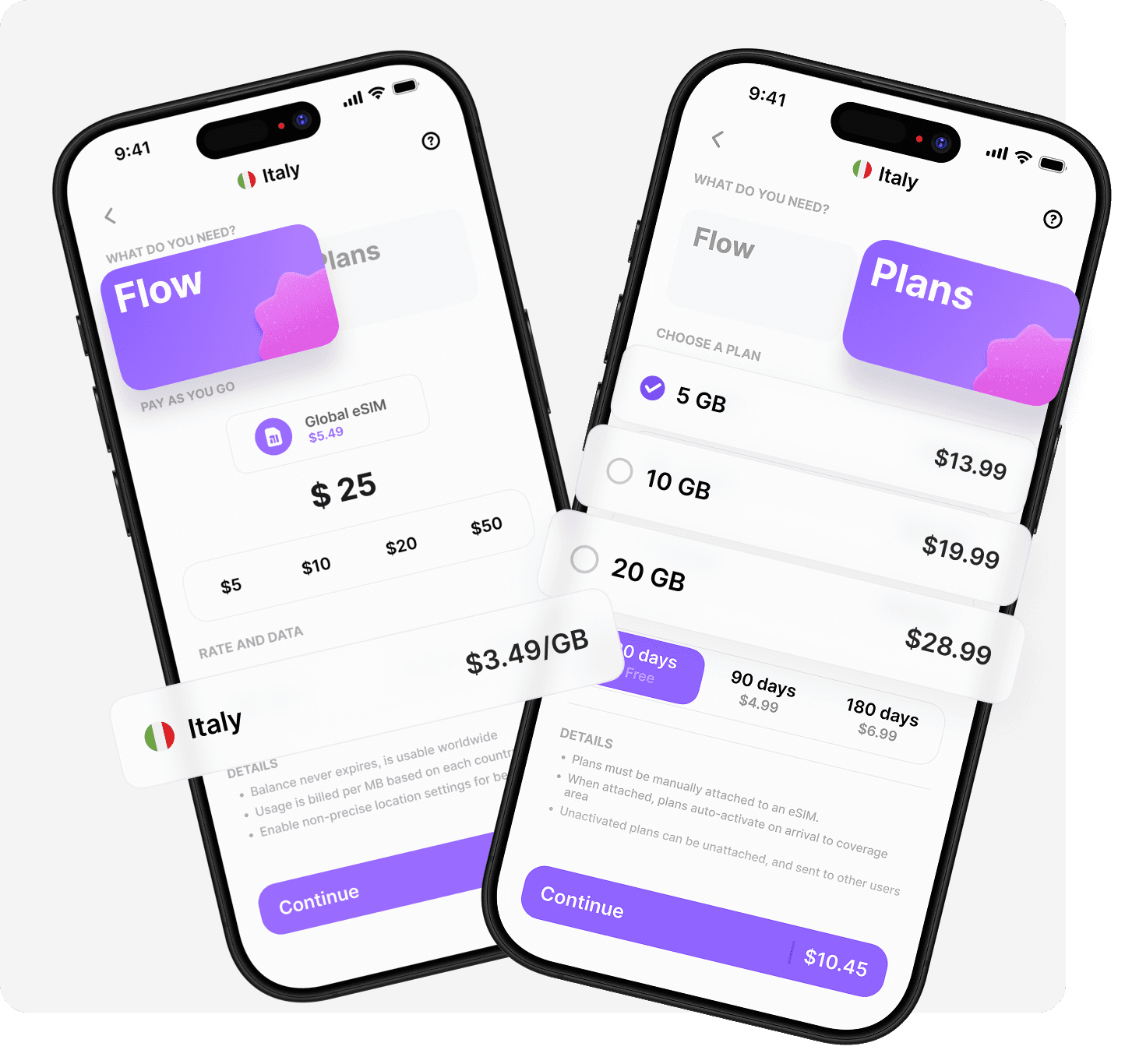
Umi's Universal eSIM runs on Tele2 in Russia, the operator that implemented the 24-hour timer correctly from the start, with 4G/5G that is never throttled and unlimited hotspot. It is one install in the app, covers 200+ other destinations on the same profile, and can be reinstalled from the app, so there is no single-use QR code to lose. Prices from the live Russia page on 19 October 2026: pay as you go at $3.95/GB, or Plans of 5GB for $17.95, 10GB for $29.55, 20GB for $50.95 and 50GB for $117.55. Whatever balance is left when you leave stays in your account for the next country, as explained in eSIM data that never expires.
Two honest caveats. Umi's eSIM is data-only, so if the operator's captcha SMS does not reach it, the first day is WiFi; and no eSIM, ours included, gets round regional shutdowns or the blocks on foreign apps. For the same practical treatment of a neighbouring rule, see using a foreign phone in Turkey, and for the broader question of what a travel eSIM does with your data, are travel eSIMs safe. Our best travel eSIM guide covers the field.
Heading to Russia? Install your Universal eSIM before you fly, download your maps, and give day one to WiFi.












" height="15.96587083656648px" id="gUt8q3MIs" width="13.557999603271485px"/></svg>)