What Is an eSIM? Travel eSIMs Explained
Written By:
Umi

So what is an eSIM? It is a SIM card built into your phone instead of a plastic chip you slot in. The eSIM meaning is right there in the name: the "e" stands for embedded. Rather than posting you a card, a network sends a digital profile you download in minutes, so you can switch plans or connect abroad without ever touching a tray. This guide explains what an eSIM is, how it works, and what a travel eSIM does specifically, so you can decide whether one suits the way you travel.
Key takeaways
An eSIM is an embedded, digital SIM. There is no physical card to insert, lose, or swap.
You download a profile in minutes, so you can be online the moment you land instead of queuing for a local SIM.
A travel eSIM is a profile sold for use abroad. The best ones cover many countries on one install and let you avoid roaming charges.
eSIMs are data-only on most travel plans, so you keep your existing SIM for calls and texts.
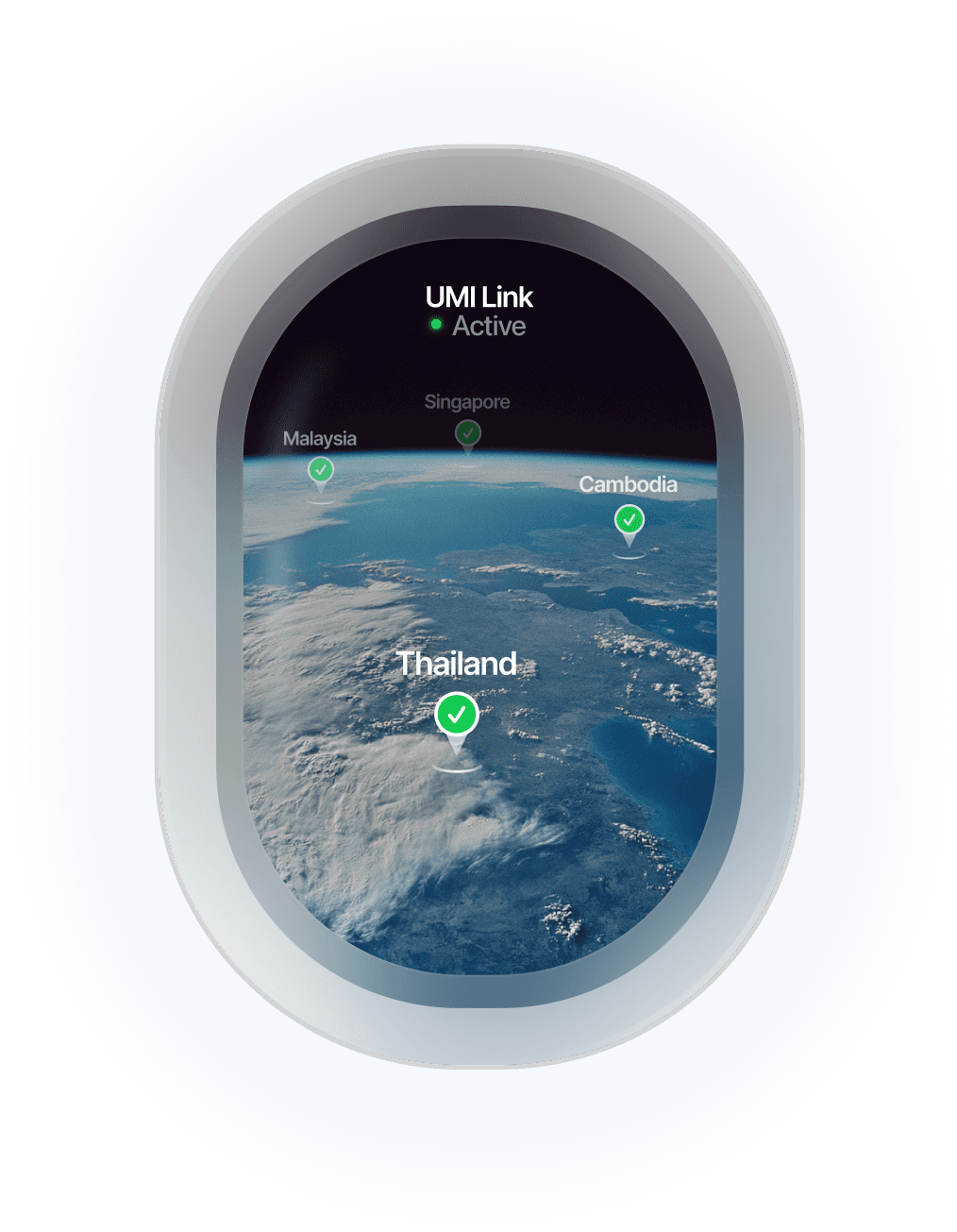
One Umi Universal eSIM works across 200+ destinations on a pay-as-you-go balance that never expires.
What is an eSIM?
An eSIM is a digital SIM embedded in your device that does the same job as a plastic SIM card without the plastic. It stores the details your phone needs to connect to a mobile network, but instead of arriving in the post, it is downloaded as a profile. Most flagship phones made since around 2018 have an eSIM chip already built in, waiting for a profile to be loaded onto it.
The practical effect is speed and flexibility. You can buy a plan online, install it in under a minute, and hold several profiles on one phone, switching between them in your settings. There is no tiny card to handle, no tray to prise open with a pin, and nothing to lose down the back of a seat.
What is a travel eSIM, and how is it different from a carrier eSIM?
A travel eSIM is a profile you buy to get data abroad, rather than a plan from your home network. A carrier eSIM is just the digital version of your normal monthly contract. A travel eSIM is built for trips: it gives you local or regional data in the countries you visit, at a fraction of what your home carrier charges to roam, and you install it before you fly.
The difference that matters is coverage and cost. Your home carrier's eSIM still bills roaming rates when you leave the country. A travel eSIM is priced for the destination, so a week of data in Spain or Japan costs far less than roaming would. The best travel eSIMs go further and cover many countries on a single profile, so you do not buy a new one at each border. If you want to compare options once you understand the basics, our guide to the best travel eSIM breaks down how to choose.
What types of travel eSIM are there?
Travel eSIMs come in three broad types, and the right one depends on your itinerary. A single-country plan covers one destination and suits a trip that stays put. A regional plan covers a group of countries, such as Europe or Asia, and fits a tour through neighbouring states. A global or universal plan covers many countries worldwide on one profile, which is the simplest option for anyone who crosses several borders or travels often.
The trade-off used to be price against convenience: single-country plans were cheapest per gigabyte, global plans most convenient. That gap has narrowed, and for multi-country trips a universal eSIM usually wins outright, because buying and installing a separate plan at every border costs more time and often more money than one profile that follows you. If your trips are nearly always to one place, a local plan is fine; if they are not, a universal eSIM saves the juggling.
How does an eSIM work?
An eSIM works by loading a network profile onto the embedded chip in your phone, then activating it so the phone connects just as it would with a physical card. You buy a plan, receive the profile as a QR code or an in-app install, add it to your phone, and select it for data. The chip is reprogrammable, which is why one eSIM slot can hold many profiles over time.
Behind the scenes, the profile carries the same credentials a plastic SIM would: the identifiers that tell a mobile network who you are and what you have paid for. When you arrive in a country, the eSIM connects to a local partner network automatically, the same way your phone finds a signal at home. The only real change is that the "card" is software, provisioned over the internet rather than slotted into a tray.
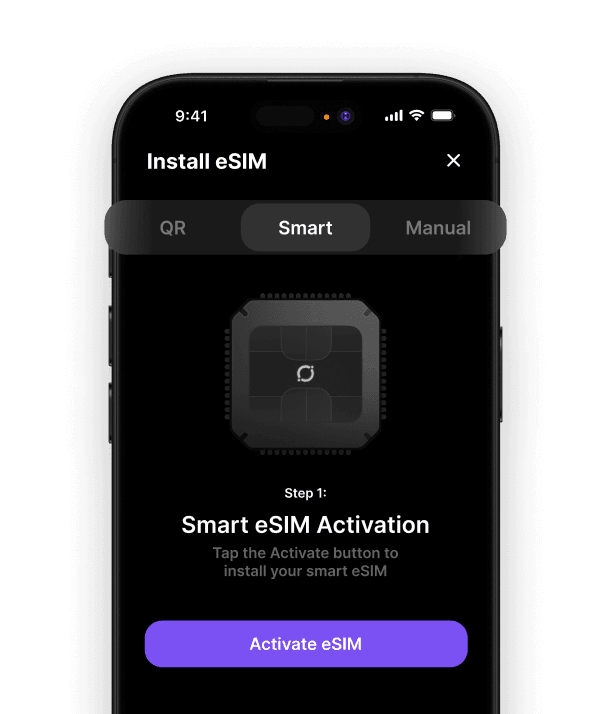
Installation comes in two flavours. The older method is a QR code you scan from another screen, which loads the profile onto your phone. The newer and simpler method is an in-app install, where you buy and activate the plan inside the provider's app and never handle a code at all. Either way, nothing is physically swapped, your existing SIM stays exactly where it is, and the whole process usually finishes in under a minute on a normal WiFi connection.
Is there a physical eSIM card?
A common question is exactly this: what is an eSIM card, and where do you buy the plastic? The answer surprises people. There is no separate physical eSIM card to buy or insert. The "card" is the embedded chip already inside your phone, and the plan is a profile downloaded onto it. When a provider talks about an "eSIM card", they mean the digital profile, not a piece of plastic.

Here is how the two compare in practice.
Physical SIM | eSIM | |
|---|---|---|
Form | A plastic card you insert | An embedded chip, already in the phone |
Getting one | Posted, or bought in a shop | Downloaded as a profile in minutes |
Switching plans | Swap the card by hand | Switch profiles in settings |
Abroad | Buy a local SIM at the airport, or roam | Install a travel profile before you fly |
Losing it | Easy to misplace a tiny card | Nothing physical to lose |
Multiple numbers | One card at a time per slot | Several profiles held at once |
Why would you want an eSIM for travel?
The main reason is to stay connected abroad without paying roaming charges or hunting for a local SIM. The benefits of eSIM technology stack up quickly for travellers: you land already set up, so maps, messaging, and transit apps work the moment you turn off airplane mode, with no airport kiosk, no deposit, and no foreign-language paperwork. For most travellers that convenience, plus the saving over roaming, is the whole case.
There is a practical edge too. Because the profile installs before you leave home, you are never stuck offline in the gap between landing and finding WiFi, which is exactly when you need directions. Picture landing at a busy airport at night in a country whose language you do not read: with a travel eSIM already active, your maps, ride-hailing app, and translation tool work before you reach the taxi rank, instead of after you have found a WiFi hotspot and a kiosk. And because an eSIM sits alongside your normal SIM, your everyday number keeps working for the calls and texts that still need it.
What are the downsides of an eSIM?
eSIMs have real limits worth knowing before you rely on one. The biggest is device support: phones older than roughly 2018, and a few budget models, do not have an eSIM chip, so they cannot use one at all. It is worth checking your handset first with our guide to eSIM supported phones.
Two other caveats matter. Moving an eSIM to a new phone is less simple than popping out a card, because the profile has to be transferred or reissued, and not every provider allows a reinstall. Many travel eSIMs are one-time install, so deleting one can lose it for good. Always check whether your provider supports reinstalling before you delete a profile. Umi's eSIM can be reinstalled, which makes it safe to manage on the move. Finally, most travel eSIMs are data-only, so they do not replace your phone line for traditional calls and texts.
Does an eSIM give you a phone number?
Usually not, in the case of a travel eSIM. Most travel eSIMs sell data only, so they do not come with a phone number for traditional calls or texts. You keep your existing SIM and number active for those, and use the eSIM purely for mobile data while you are abroad. That dual-SIM setup is normal and is what keeps your usual number reachable.
Carrier eSIMs are different: an eSIM from your home network or a local operator can carry a phone number, because it is a full line rather than a data plan. The distinction is the plan, not the technology. Umi is data-only today, with calls and texts coming soon, so treat it as your data layer and keep your home SIM for calls.
Are eSIMs safe?
Yes, an eSIM is at least as safe as a physical SIM, and in some ways safer. Because there is no card to remove, a thief cannot pull your SIM out of a lost phone and use it elsewhere, which closes off one simple route to number theft. The profile is tied to your device and provisioned over an encrypted connection.
The usual sensible habits still apply: keep your phone passcode-locked, enable remote wipe, and be cautious on untrusted public WiFi. None of that is specific to eSIMs, but it is good practice when you travel. For a fuller look at security and privacy on the road, see our guide on whether travel eSIMs are safe.
Which phones support eSIM?
Most phones released since about 2018 support eSIM, including recent iPhones from the XR and XS onward, Google Pixel from the 3 onward, and many Samsung Galaxy S and Note models from the S20 era. Some newer iPhones sold in the United States are eSIM-only, with no physical tray at all, which shows how far the technology has moved into the mainstream.
The exceptions are older handsets, certain budget devices, and a few region-specific models that ship without the chip. Because the list changes with every release, check your exact model before buying a plan. Our roundup of eSIM supported phones keeps a current view, and your phone's settings will usually show an "Add eSIM" or "Add mobile plan" option if it is compatible.

How do you get and set up a travel eSIM?
Getting a travel eSIM takes a few minutes and three steps: buy a plan for your destination, install the profile, and select it for data when you arrive. With an app-based provider the whole thing happens in the app, with no QR code to scan, and setup typically takes under a minute. You can do it at home before you fly, then simply switch the eSIM on when you land.
For the full walkthrough, including how to keep your home SIM active for calls, see our step-by-step guide to setting up an eSIM. Where you buy matters too: check the plan covers every country on your trip and that the data does not expire before you have used it, because a cheap plan that deletes your balance after a few days is not cheap if you only used half.
How much does an eSIM cost?
A travel eSIM usually costs a few dollars per gigabyte on pay-as-you-go, with fixed bundles dropping the per-gigabyte rate when you commit to a set amount up front. There is no single price, because it depends on the destination and how much data you use, but the headline point is that it is far cheaper than your home carrier's roaming rates for the same data abroad.
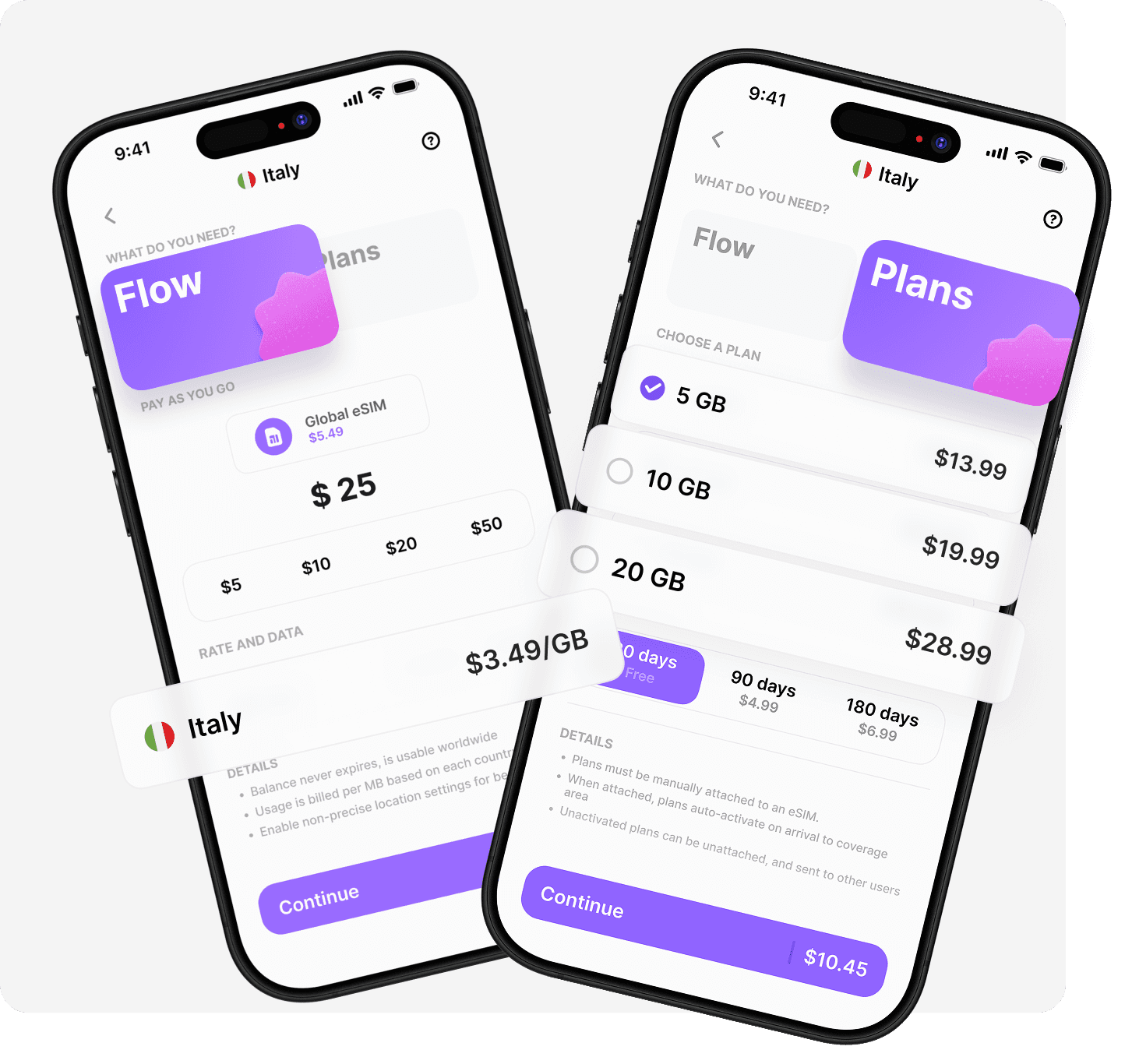
The honest way to judge cost is the rate per gigabyte multiplied by the data you realistically use, not the cheapest banner price. A low day-rate that deletes your balance after five days is not cheap if you only used half of it, so factor in expiry. Umi's pay-as-you-go Flow runs from $2.55 per GB on the global baseline, with per-country rates varying by destination, and the balance does not expire, so nothing you buy is wasted. Always check the current rate on the live destination page, as prices change.
Can you have more than one eSIM on your phone?
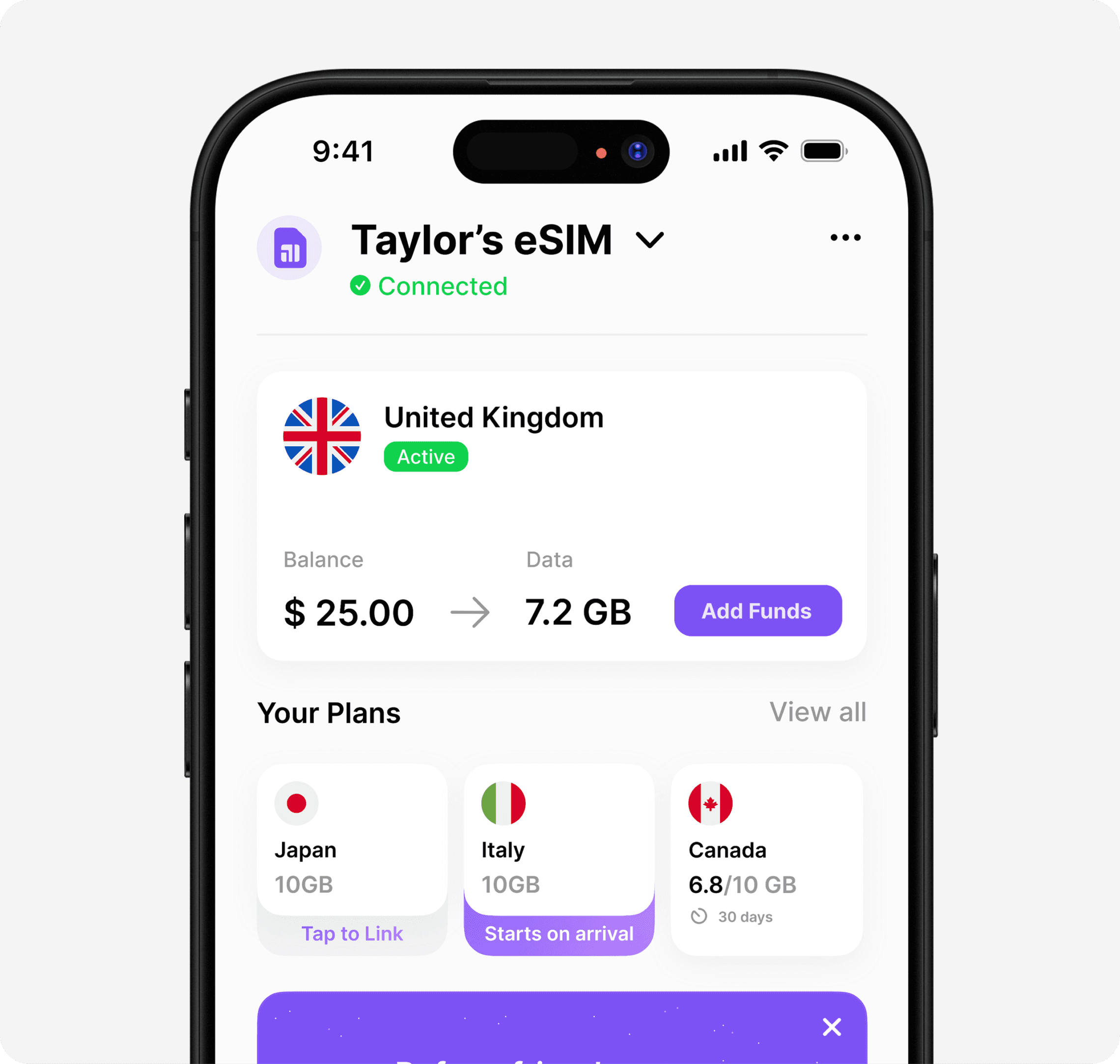
Yes. One of the advantages of the technology is that a single phone can store several eSIM profiles at once, even though you typically use one or two for data at a time. That is what makes the common travel setup work: your home SIM stays active for calls and texts while a travel eSIM handles data abroad, both on the same handset.
It also means you can keep profiles for different countries or trips and switch between them in your settings, rather than juggling plastic cards. The exact number of profiles a phone can hold varies by model, and only one or two can be active at the same moment, but the flexibility is a clear step up from a single physical tray. For travellers who carry a separate work line, it keeps everything on one device.
Where a travel eSIM like Umi fits
If you have decided an eSIM suits you, the thing to look for is one that covers everywhere you go without buying a new plan per country, and that does not waste the data you paid for. That is the gap a Universal eSIM fills. One Umi eSIM works across 200+ destinations on a single install, on premium local 4G and 5G, so a multi-country trip runs on the same profile with no swapping.
Umi runs on a pay-as-you-go Flow balance that never expires, so data you buy for one trip carries to the next instead of vanishing when you land home. Setup takes under 60 seconds in the app, and the eSIM can be reinstalled if you change phones. It is data-only, so keep your usual SIM for calls and texts. To get started, compare travel eSIM options or browse the destination guides for the countries on your trip: the USA, Japan, the UK, and Europe.
Sources: GSMA on eSIM technology; eSIM (Wikipedia); Apple eSIM support for device compatibility.












" height="15.96587083656648px" id="gUt8q3MIs" width="13.557999603271485px"/></svg>)