Unlimited Data eSIM: The Real Daily Caps by Provider
Written By:
Umi

No unlimited data eSIM is unlimited. Every one of them has a daily high-speed allowance written into a fair-use policy, after which your connection drops to around 1 Mbps for the rest of the day, and the only real difference between providers is whether they tell you the number before you pay. Airalo does: 3GB a day. Nomad does: 2GB. Saily does, by destination: 3GB or 5GB. Holafly does not publish one, and in practice slows you down after about 2GB to 3GB. This guide sets out the caps as the providers themselves state them, what 1 Mbps actually feels like on a phone, the arithmetic that shows when an "unlimited" plan is good value and when it is the most expensive way to buy data, and the alternative of simply paying for the gigabytes you use at full speed.
Quick answer: "Unlimited" means unlimited at a reduced speed after a daily cap, typically 2GB to 5GB. At the throttled speed of about 1 Mbps, maps and messaging work, video calls stutter and streaming above standard definition does not play. If you will use more than 3GB every single day and can live with the evening slowdown, an unlimited plan is cheaper per gigabyte than anything else. If you use less, which is most travellers, you are paying $3 to $7 per gigabyte for the word. Umi does not sell unlimited plans. Its Universal eSIM runs at full 4G/5G speed on every gigabyte, with unlimited hotspot, on a pay-as-you-go balance from $2.55/GB that never expires.
Is unlimited eSIM data really unlimited?
No, and the providers say so in their own terms, just not on the plan page. The mobile networks that travel eSIMs ride on impose fair-use rules on roaming traffic, so no reseller can offer truly uncapped data without going bankrupt on wholesale fees. What they sell instead is a daily allowance of high-speed data, after which the network throttles the connection to a speed that keeps messages flowing but little else, resetting 24 hours later. Nomad's own blog puts it plainly: most unlimited plans carry "a daily high-speed allowance (e.g. 1–3GB/day)" controlled by a fair usage policy, and reduced speeds "may only support basic tasks like messaging or email".
The word survives because it sells, and because the cap is rarely on the checkout page. It is in a fair-use policy, a help-centre article or, in one case, nowhere at all.
What are the actual daily caps, by provider?
These are the figures each provider publishes, read in October 2026, with the gaps marked honestly.
Provider | Daily high-speed allowance | Speed after the cap | Hotspot on unlimited | Where it is stated |
|---|---|---|---|---|
Airalo | 3GB per day by default; a different figure is shown in the package details where it applies | 1 Mbps for the rest of that day; resets 24 hours from activation | No stated limit on tethering | |
Nomad | 2GB per day on most plans | About 1 Mbps or 2 Mbps depending on the plan; renews 24 hours after activation | Not addressed in the help article | |
Saily | 3GB or 5GB per day depending on the destination offer | Up to 1 Mbps after the allowance | Supported, with restrictions on heavy or continuous tethering | Fair-use terms, as reported in reviews checked October 2026 |
Holafly | About 2GB to 3GB per day in practice. Holafly does not publish a figure: its terms say speed "may be subject to a network service provider's fair use policy" and plan pages say slowing lasts "no more than one day" | Reduced speed for the rest of that day, comparable to the others at around 1 Mbps; resets the next day | 1GB per day of shareable data | Terms and conditions, clause 6.3 |
Two things stand out. First, the caps cluster at 2GB to 5GB a day, which is the range the networks will tolerate, so "unlimited" from any provider means roughly the same thing. Second, Holafly, the brand that built its business on the word, is the only one of the four that does not tell you the number. That is not an accident: an unpublished cap cannot be compared, and the plan page can keep saying unlimited.
What does 1 Mbps actually feel like?
Slow enough to notice within a minute. For reference, a standard-definition video stream needs about 1 to 1.5 Mbps, 720p needs around 3 Mbps, 1080p around 5 Mbps, and a one-to-one video call needs 1.5 to 3 Mbps to stay sharp. At 1 Mbps you get:
Messaging, email and maps: fine, with the occasional pause loading map tiles.
Web browsing: slow; image-heavy pages take ten to twenty seconds.
Social media feeds: usable, with videos buffering.
Video calls: possible at low quality, with freezes.
Streaming: standard definition at best, and often buffering.
Uploading photos or backing up: effectively off until the cap resets.
The practical effect is that an unlimited plan gives you a full-speed morning and a slow evening on any day you use it heavily, which is exactly the day you bought "unlimited" for.

When is an unlimited plan actually good value?
When you use close to the cap every day. The arithmetic is simple once you know the cap. Airalo's Europe unlimited plan is $35 for 10 days at the time of writing, with a 3GB daily cap, so the most high-speed data it can ever deliver is 30GB, or $1.17 per gigabyte. Holafly's equivalent is $37.50 for 10 days; with the slowdown arriving at about 2GB to 3GB a day, the ceiling is 20GB to 30GB, or $1.25 to $1.88 per gigabyte. Saily's 15-day Europe plan is $49.99 with a 5GB cap, so up to 75GB at $0.67 per gigabyte. Used to the limit, those are the cheapest high-speed gigabytes on the market, and for a remote worker on video calls all day who can tolerate a slower evening, an unlimited plan is the right buy.
Now the same plans for the way most people travel. The typical visitor uses between half a gigabyte and one gigabyte a day: maps, messaging, a few photos uploaded, restaurants looked up. Over the same 10 days that is 5GB to 10GB.
Plan | Price | High-speed ceiling | Cost per GB used at 3GB a day | Cost per GB used at 1GB a day | Cost per GB used at 0.5GB a day |
|---|---|---|---|---|---|
Airalo Europe unlimited, 10 days | $35.00 | 30GB | $1.17 | $3.50 | $7.00 |
Holafly Europe unlimited, 10 days | $37.50 | about 20GB to 30GB | $1.25 to $1.88 | $3.75 | $7.50 |
Saily Europe unlimited, 15 days | $49.99 | 75GB | $0.67 (5GB a day) | $3.33 | $6.67 |
Umi Europe 10GB Plan | $29.95 | 10GB, never throttled | n/a | $3.00 | $3.00 (5GB left over, never expires) |
Umi pay as you go | $2.55 per GB | whatever you buy, never throttled | $2.55 | $2.55 | $2.55 |
The pattern is the point. An unlimited plan is a bet that you will use a lot every day. Win the bet and it is cheap; lose it and you have paid $3.50 to $7.50 per gigabyte for data that was never used, and the plan expires at the end of the trip either way. Per-gigabyte pricing is the same cost whatever you use, at full speed throughout, and on Umi the balance you do not use is still there for the next trip. Our Airalo vs Holafly comparison runs the same numbers for Japan, and eSIM data that never expires covers what a carried-over balance is worth across a year of travel.
Does Airalo have unlimited data, and what are the limits?
Yes, since 2025, in many countries and regions, and Airalo is the most transparent of the big providers about it. The default daily high-speed threshold is 3GB, speeds drop to 1 Mbps for the rest of that day once you pass it, the allowance resets every 24 hours counted from activation, and there is no limit on tethering or the number of devices you connect. Where a package uses a different threshold, Airalo says it will be shown in the package details before you buy, so check the "additional information" on the plan you are looking at. Airalo also still sells fixed packages from 1GB upwards, which are the better buy for light users as long as you size them honestly, since whatever is left expires with the package.

How do I find the cap on a plan before I buy?
Five minutes, and it saves the argument with support later:
Open the plan page and look for "fair use", "fair usage", "FUP" or "high-speed" in the small print under the price. If there is a number, that is your daily cap.
If the plan page has nothing, search the provider's help centre for "fair use policy" or "unlimited". Airalo and Nomad both keep a dedicated article.
If the help centre has nothing either, read the terms and conditions for the word "unlimited". If the terms only say speed "may be restricted" with no figure, assume 3GB a day and plan for it.
Check the hotspot line separately. A daily tethering cap of 500MB to 1GB makes a plan useless for laptop work even when the phone cap is generous.
Check the reset rule. Most caps reset 24 hours from activation, not at midnight, so a late-evening activation gives you an odd cycle for the whole trip.
If you cannot find the number after those five steps, that is your answer about the provider.
What is the alternative to an unlimited eSIM?
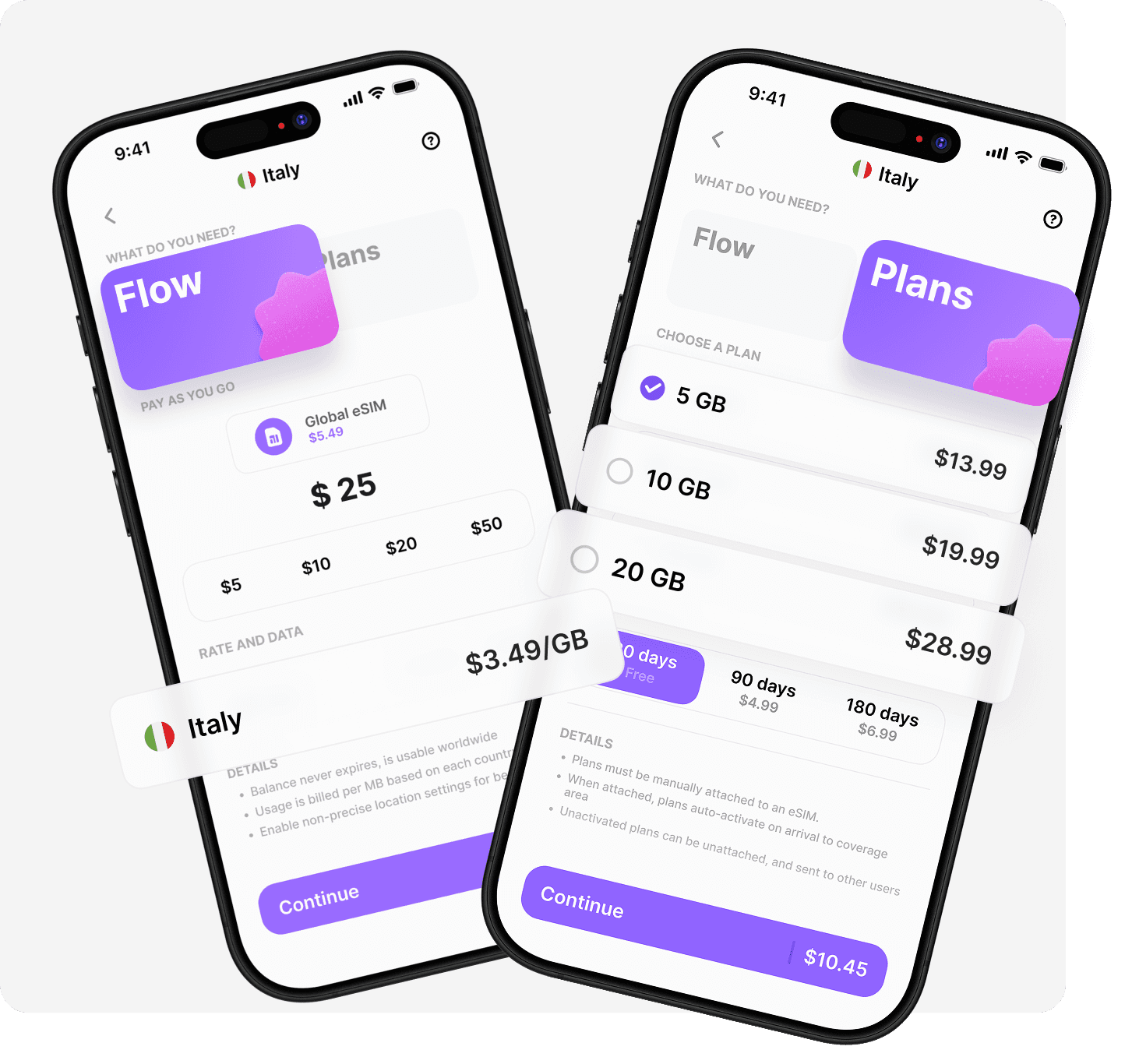
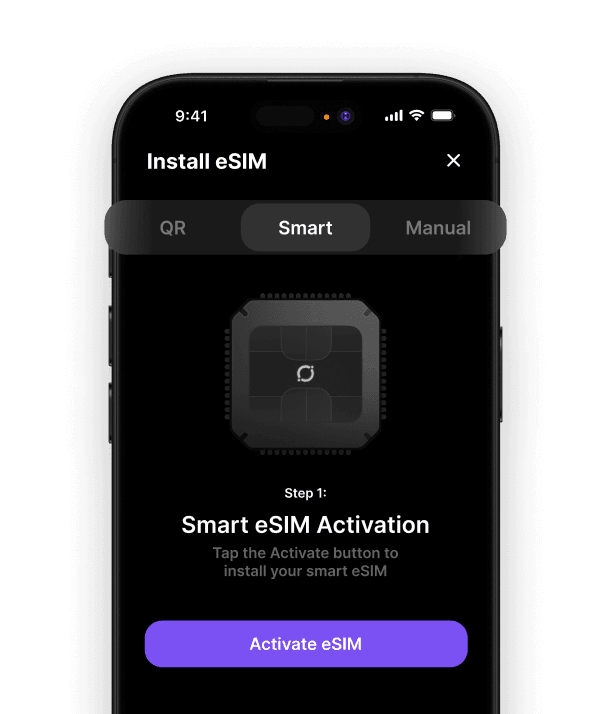
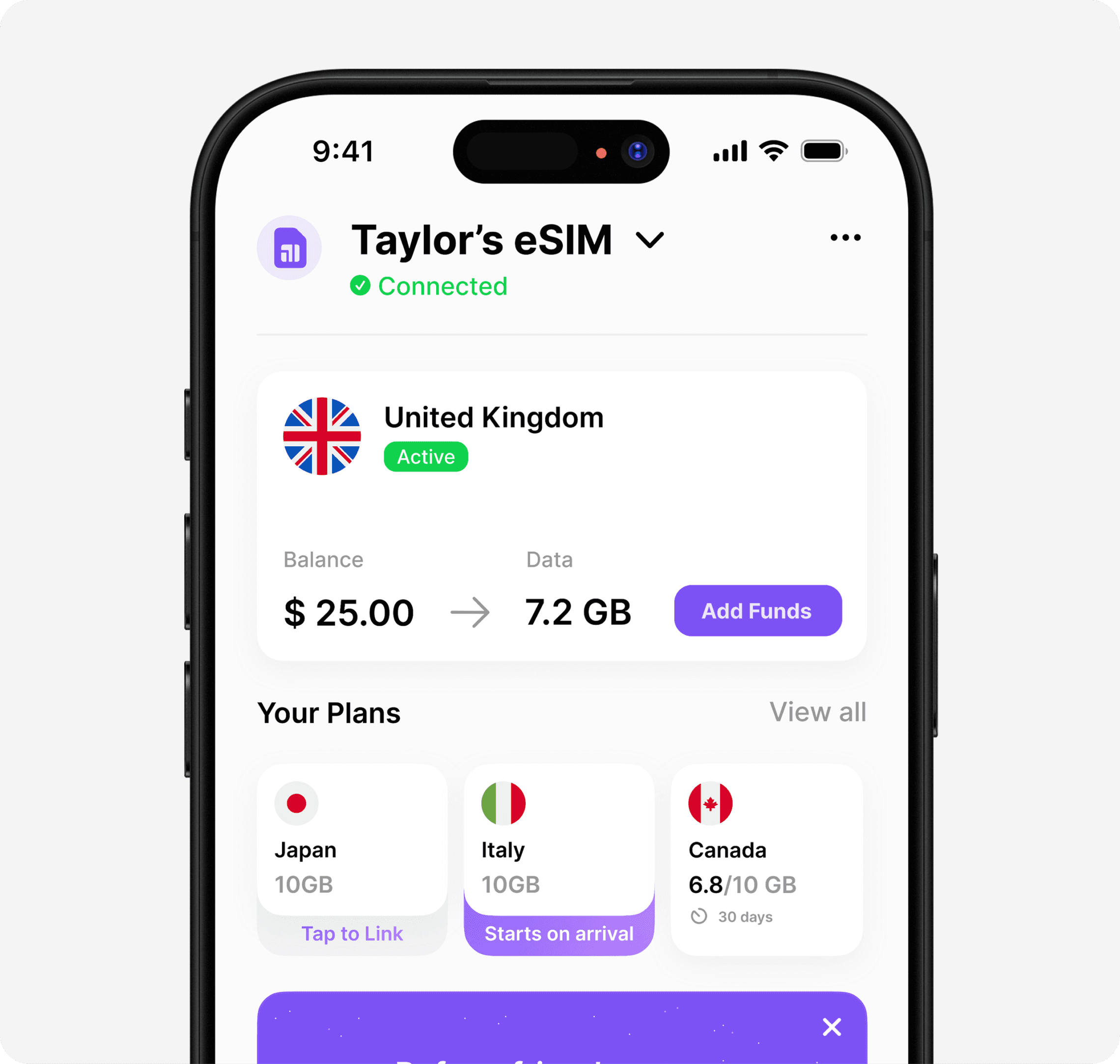
Buy data instead of days. Umi's Universal eSIM is installed once, in the app, in under 60 seconds, and works in 200+ destinations. You either choose a country or regional Plan sized for the trip, 10GB for Europe at $29.95 for example, or top up a pay-as-you-go balance from $2.55/GB and spend it wherever you go. Every gigabyte is delivered at full 4G/5G speed with no daily threshold, hotspot and tethering are unlimited and draw from the same balance, and whatever is left when you fly home stays in your account. There is no fair-use clause to find, because there is nothing to find: you bought 10GB, you get 10GB at the network's full speed.
The honest trade-off is the one in the table. If you will stream and video-call through 3GB or more every day and the slowdown does not bother you, an unlimited plan from Airalo or Saily is cheaper per gigabyte than Umi. For the far larger group who use a gigabyte a day or less, pay-as-you-go costs less, runs faster all day, and does not expire. For how Umi compares with the whole field, see our best travel eSIM guide.
Want full speed on every gigabyte and nothing to read in the small print? Install your Universal eSIM and top up a pay-as-you-go balance before you fly.












" height="15.96587083656648px" id="gUt8q3MIs" width="13.557999603271485px"/></svg>)